2018 Legislation
SB 1547: Oregon Chiropractors, Naturopathic
Physicians, Physical Therapists and Occupational Therapists May Assess 'Return to Play' in Concussed Student Athletes
Legislation passed in Oregon in 2018, Senate Bill 1547, inserts chiropractors,
naturopathic physicians, physical therapists and occupational
therapists into the list of qualified health professionals who may assess a concussed student athlete and provide a release for that athlete to begin the current evidence-based process for return to play and academic protocols. The law requires the non-MD providers to first complete a special course that will be produced by Oregon Health and Sciences University.
Read the bill.
March 3, 2018: President signed.
March 2, 2018: Speaker signed.
April 13, 2018: Governor signed.
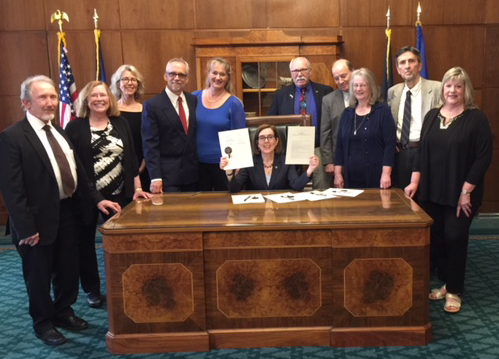
Standing from left to right: Tim Ray, Brain Injury Alliance ED Sherry Stock, Representative Keny-Guyer, Dr. Ted Forcum, Dr. Laurie Lajoie, Senator Arnie Roblan, OCA Lobbyist Dr. Vern Saboe, Senator Laurie Monnes Anderson, OCA Pres. Dr. Will Schnieder, OCA's ED Jan Ferrante and sitting is Governor Kate Brown
2013 Legislation
SB 721 Jenna's Law Sports Concussion Legislation
Fact Sheet - Relating to youth athletic team safety.
Imposes on nonschool athletic teams requirements for recognizing and responding
to possible concussions. Annual concussion training for all coaches
and referees; remove from play if showing signs and/or symptoms of
concussion and must have a medical release to return to play;
distribution of information concussion to parents and students 12
and over, both required to sign form confirming receipt of
information.
Sponsor By Senators STEINER HAYWARD, GIROD, Representative GILLIAM; Senators BURDICK, COURTNEY, DEVLIN, DINGFELDER, EDWARDS, FERRIOLI, MONNES ANDERSON, MONROE, ROBLAN, THOMSEN, Representatives BARTON, BOONE, FREDERICK, GREENLICK, KENY-GUYER, WILLIAMSON
Jun 17, 2013: President signed.
Jun 18, 2013: Speaker signed.
Jun 25, 2013: Governor signed.

Ceremonial Signing Sept 16, 2013.
Left to right: Sen. Knopp, Dave Kracke, Jenna Sneva, Governor
Kitzhaber,
Sen. Steiner-Hayward, Dr. Jim Chesnut, Ronda Sneva
(picture taken by Lili Koenicke)
Find Your Representative
Vote Smart is a useful website that will help you find who your Representatives are.
Visit the Vote Smart website.
Legislation Passed
2007
March as Brain Injury Awareness Month
in Oregon
The month of March in
each year is designated as Brain Injury Awareness Month. All Oregon
citizens are urged to recognize that knowing the consequences of
traumatic brain injury is critical to public understanding, and that
this understanding can lead to the prevention of traumatic brain
injury and enhance the recovery process for traumatic brain injury
survivors.
SJR 21
2009
Max's Law - Sports Concussion
SB 348
Requires each school district to ensure that coaches receive annual training to learn how
to recognize the symptoms of a concussion and how to seek proper medical treatment for a
person suspected of having a concussion.
A coach may not allow a member of a school athletic team to participate in any
athletic event or training on the same day that the member:
(A) Exhibits signs, symptoms or behaviors consistent with a concussion following an observed
or suspected blow to the head or body; or
(B) Has been diagnosed with a concussion.
A coach may allow a member of a school athletic team who is
prohibited from participating in an athletic event or
training who appears to have sustained
to participate in an athletic event or training no sooner than the day after the member experienced
a blow to the head or body and only after the member:
(A) No longer exhibits signs, symptoms or behaviors consistent with a concussion; and
(B) Receives a medical release form from a health care professional.
This 2009 Act takes effect
July 1, 2009.
SB348
Click on this link for a copy of the legislation
OAR 581-022-0421

Max Conradt and Governor Ted Kulongoski signing Max's Law

Left to right: David Kracke, Max Conradt, Governor Ted
Kulongoski, Tootie Smith, Sherry Stock
Max's Law: one tragedy that needn't
be repeated
By Galen Barnett, The Oregonian
Oregonian
A few years ago, Max Conradt was an exceptional high
school scholar athlete when he suffered his first concussion
on a southern Oregon football field. After suffering a
second concussion in a game the following week, Max was
unconscious and in a coma that would last for four months.
Today Max is in a long-term care facility doing his best to
cope day by day, surrounded by family and friends who do
what they can to make his life better.
Max suffers from Second Impact Syndrome, which occurs
when a person receives a second concussion in close temporal
proximity to a first concussion.
The second concussion re-injures already weakened brain
cells, causing the devastating brain injury that Max will
endure for the rest of his life.
Unfortunately, Max's high school football coach didn't
appreciate the fact that Max's brain was struggling to
recover from the first concussion when Max was allowed to
play in that fateful next game. Had the coach understood the
causes of Second Impact Syndrome, Max would have been
watching that next game from the sidelines instead of taking
punishing blows at quarterback.
Max's story may have ended in that care facility were it
not for the efforts of Max's father, Ralph, and the tireless
advocacy of many doctors, state athletic administrators and
the staff of the Brain Injury Association of Oregon, who
were motivated by Max's tragedy to support legislation
requiring that all high school athletic coaches in Oregon
receive concussion recognition training.
The law, known as "Max's Law," was signed by Gov. Ted
Kulongoski after it passed unanimously through the House and
Senate and is now the law of the state of Oregon. It's a
landmark law that will save young lives and serve as a model
for other states seeking to address the issue of concussion
recognition among youth athletic coaches.
Brain injuries are often misunderstood by the public and
even by the victims of the injury themselves. In the case of
a high school athlete who suffers a concussion, there are
many pressures to get back onto the field. The team needs
the player, there are league standings to consider, not to
mention the college scouts who might be at any given game.
An athlete can be forgiven if he (or she) thinks that the
world depends on him being out on the field. But, as anyone
who knows Max Conradt will tell you, the cost of an early
return to play can have devastating, life-changing results.
Max was on his way to an Ivy League school before his
injury. Now he struggles with the most basic physical tasks.
No one can pretend that the benefit of Max being on the
field for that next game outweighs for even a second the
life that he now leads.
High school is typically about teaching kids. What Max's
Law recognizes is that sometimes it's the adults who need
the lessons. Concussions occur in every sport, with boys'
football having the highest prevalence of concussions,
followed closely by girls' soccer. Straightforward
concussion-recognition training will teach coaches that when
a player suffers a head trauma on the field, it's not to be
taken lightly. Coaches will learn what symptoms to look for
and to advise that the player seek medical attention when a
concussion is suspected. When a concussion is diagnosed, the
coach will know that the player needs to sit out until the
player has been symptom-free for at least a week. As any
sports injury doctor will tell you, "When in doubt, sit them
out."
Max's coach didn't follow this advice, and Max will
suffer the consequences for the rest of his life. Max's Law,
however, will go a long way toward ensuring that such a
tragedy never happens again.
Published: Wednesday, June 10, 2009, 7:30 AM Oregonian
http://www.oregonlive.com/opinion/index.ssf/2009/06/maxs_law_one_tragedy_that_need.html
OAR 581-022-0421
The Oregon Administrative Rules contain OARs filed
through July 15, 2010
OREGON DEPARTMENT OF EDUCATION
DIVISION 22
STANDARDS FOR PUBLIC ELEMENTARY AND SECONDARY
SCHOOLS
581-022-0421
Safety of School Sports—Concussions
(1) As used in this rule:
(a) “Annual training” means once in
a twelve month period.
(b) “Coach” means a person who instructs
or trains members on a school athletic team and may be:
(A) A
school district employee;
(B) A person who volunteers for a
school district
(C) A person who is performing services on behalf
of a school district pursuant to a contract.
(c) “Concussion”
means exhibiting signs, symptoms or behaviors consistent with a
concussion following an observed or
suspected blow to the head
or body.
(d) “Health Care Professional” means a Physician (MD),
Physician’s Assistant (PA), Doctor of Osteopathic (DO) licensed by
the
Oregon State Board of Medicine, nurse practitioner licensed
by the Oregon State Board of Nursing, or Psychologist licensed
by the Oregon Board of Psychologist Examiners.
(e) “Proper
medical treatment” means treatment provided by a licensed health
care professional which is within their scope
of practice.
(f) “Return to participation” means a student can rejoin the
athletic event or training.
(g) “Training timeline” means every
coach receives the training prior to the beginning of the season for
the school athletic
team they are speci!cally coaching.
(h)
“Same day” means the same calendar day on which the injury occurs.
(2) Each school district shall:
(a) Develop a list of coaches.
(b) Identify which community (may include state or national)
resources the district will use to provide the training as
required in section (3) of this rule.
(c) Develop training
timelines for coaches of all school athletic teams.
(d) Ensure
coaches receive training once every twelve months.
(e) Develop a
tracking system to document that all coaches meet the training
requirements of this rule.
(f) Ensure no coach allows a member of
a school athletic team to participate in any athletic event or
training on the same
calendar day that the member:
(A)
Exhibits signs, symptoms or behaviors consistent with a concussion
following an observed or suspected blow to the
head or body; or
(B) Has been diagnosed with a concussion.
(g) Ensure no coach
will allow a student who is prohibited from participating in an
athletic event or training, as described in
section (2)(f), to
return to participate in an athletic event or training no sooner
than the day after the student experienced
a blow to the head or
body. The student may not return to participate in an athletic event
or training until the following
two conditions have been met:
(A) The student no longer exhibits signs, symptoms or behaviors
consistent with a concussion; and
(B) The student receives a
medical release form from a health care professional.
(3) The
training required of coaches under this rules shall include the
following:
(a) Training in how to recognize the signs and
symptoms of a concussion;
(b) Training in strategies to reduce
the risk of concussions;
(c) Training in how to seek proper
medical treatment for a person suspected of having a concussion; and
(d) Training in determination of when the athlete may safely return
to the event or training.
Stat. Auth: ORS 336.485 Stat.
Implemented: ORS 336.485
Hist.: ODE 13-2010, f. & cert. ef.
6-30-10, State Board of Ed revision 1-27-1
OAR 581-022-0421
Concussion Legislation by StateThe NFL supports and
recognizes the laws which include the following 3 points
in their legislation
including:
- Inform and educate youth
athletes, their parents and guardians and require
them to sign a concussion information form;
- Removal of a youth athlete who
appears to have suffered a concussion from play or
practice at the time of the suspected concussion;
and
- Requiring a youth athlete to be
cleared by a licensed health care professional
trained the evaluation and management of concussions
before returning to play or practice.
Interactive Map: State Laws Concerning Sport-Related Concussions among
Youth
By the beginning of 2013, a total of 49 states and the District of Columbia had legislation to prevent concussions and to limit further injury to student athletes who sustain concussions, with most of these laws mandating that student athletes who experience a concussion be removed from play and obtain a health care provider’s permission before returning to play.
For more information, please click here:
http://www.childrenssafetynetwork.org/publications/state-laws-concerning-sport-related-concussions-among-youth
Note: To see the components of your state’s law, hover over it with your cursor. To read the law itself, click on the state to view the state’s legislation page.
SB 381- TBI Health Care
Mandate
All health care plans serving members in the state of Oregon
must provide coverage
of medically necessary therapy and services for the treatment of traumatic brain injury.
SB 381
1994/2004/2015 - Bicycle Helmet Laws It's been a law in Oregon since enacted in 1994 - if you are under 16 you must wear a helmet when riding a bike. The law was expanded in 2004 to include skateboards, scooters and in-line skates.
Oregon does have a mandatory helmet law for anybody under the age
of 16. Here’s how that law works. Anybody who is riding on a bicycle
and who is under the age of 16 is required to wear a helmet. This
requirement extends to both the operator of the bicycle, as well as
any passengers on the bike (see ORS
814.485).
The mandatory helmet law also spells out exactly under what
circumstances a helmet is required. It involves a lot of legal
descriptions, but the basic idea is this: If you are riding on a
place that is used or intended for travel by vehicles, or is open to
the public, and you are under the age of 16, you are required to
wear a helmet. (For the exact requirements of the law, see
ORS
814.485,
ORS
801.305, and
ORS
801.400)).
Oregon law also requires that to meet the requirements of the
mandatory helmet law, bicycle helmets must “conform, insofar as
practicable, to national safety standards and specifications for
such headgear” (See
ORS
815.052, OAR
735-102-0030, and
16
CFR Part 1203. See also
Bicycle Helmet Standards.
1988- Mandatory Motorcycle Helmet Laws
Oregon law requires you to wear an approved motorcycle helmet whenever you ride a motorcycle or moped, as either a driver or passenger. Helmets must have a label on them saying they meet U.S. Department of Transportation (DOT) standards. Crashes can occur—particularly among untrained, beginning riders. And one out of every five motorcycle crashes result in head or neck injuries. Head injuries are just as severe as neck injuries—and far more common. Crash analyses show that head and neck injuries account for a majority of serious and fatal injuries to motorcyclists.
Research also shows that, with few exceptions, head and neck injuries are reduced by properly wearing an approved helmet. Here are some facts to consider:
• An approved helmet lets you see as far to the sides as necessary. A study of more than 900 motorcycle crashes, where 40% of the riders wore helmets, did not find even one case in which a helmet kept a rider from spotting danger.
• Most crashes happen on short trips (less than five miles long), just a few minutes after starting out.
• Most riders are riding slower than 30 mph when a crash occurs. At these speeds, helmets can cut both the number and the severity of head injuries by half. No matter what the speed, helmeted riders are three times more likely to survive head injuries than those not wearing helmets at the time of the crash.
|