Summer 2000 Vol. II Issue 2
The Headliner
The Newsletter of
the Brain Injury Association of Oregon
and the Brain Injury Support
Group of Portland
What's Inside?
Experiencing Work
In a recent study, people were asked what they needed to be happy. Three key factors were
identified: someone to love, somewhere to live, and something to do. This issue of the Headliner focuses on
the third factor: something to do.
When we introduce ourselves, we usually include a reference to our occupation: "I am
Joe, I have two kids, and I work as a ______." Clearly, the desire to work is universal, and our identity
is often strongly defined through the work we do. Regardless of whether the activity is voluntary or paid,
working helps us feel like we are contributing and often affects how we feel about ourselves.
Even a mild brain injury can have a major - and lasting - impact on a person's work life. A
wide range of new physical and cognitive challenges often make it difficult to maintain the roles and
responsibilities assumed and enjoyed prior to injury. The struggle to rebuild a work life can leave a person
feeling frustrated and devalued. One individual with a Brain injury (BI) put it this way: "I feel like I
have a neon light on my forehead that says 'Head Injured.' When will it get turned off?"
As they seek to return to work, individuals with BI and their family members often enter a
new arena where they must learn to work collaboratively with representatives of a range of agencies such as
Social Security, Employment, and Vocational Rehabilitation. Further, they must quickly become familiar with
the provisions of key legislation (such as the Americans with Disabilities Act or the new Work Incentives Act,
see p. 6) that outline their rights and options as they pursue employment.
We asked a number of individuals with BI to share their stories of the journey back to work. Some are
presented in the person's own words, others are related through Headliner staff. Each of these stories
reflects a different perspective on finding "something to do." Taken together they cover the range
from volunteering to part- and full-time employment. The stories may inspire you, or they may simply give you
comfort in knowing that your experience is shared.
Finding Her Passion: Melody
Failure was a new experience for me, yet one I began to have over and over again after my
car accident in 1993. Then I was referred to Kathy Meidle of the Vocational Rehabilitation office in Eugene.
After some testing Kathy referred me to Community Rehabilitation Services, an organization that works with
persons with brain injury. I worked with Jan Johnson. Jan helped me understand many of the challenges I was
experiencing and she taught me how to use a "Brain Book" to manage my life.
It was a process of trial and error until, with help from both Kathy and Jan, I was able to
come up with a new career that would integrate my physical and mental challenges as well as my creative,
emotional and intellectual needs. Part of my "new personality" includes an interest in technology,
so I began educating myself in the area of the film and television industry.
With Kathy's continued support, I am developing my own corporation, CHORD Enterprises. I am
involved with the making of commercials, public service announcements, independent film, video productions and
a movie. I love what I do and I am very good at it. I now succeed on my own terms and that feels great !
Volunteering Works: Chris
Before Chris's injury several years ago, she operated a successful business processing
checks for persons with disabilities. Chris attempted to continue the business after the injury but found she
was making too many mistakes. She struggled to cope with constant fatigue, poor memory, and a tendency to
become overwhelmed by tasks. Recently, medication adjustments allowed Chris to be more productive and begin
volunteer work at a nearby school.
Chris enjoys the work, but finds she still feels overwhelmed at times. "When you mess up, what
do you say? You don't always want to say it's because of the injury...I just have to tell them that I've had
too many factors in my week to do the work or that I'm having a bad brain day and I may have it for several
days. It's humbling." She also deals with internal questions about whether the work will ever go smoothly
again. Even though new tasks are hard, she finds she can handle most tasks that have some relation to past
knowledge but that everything new is hard.
. . . and Debbie
"I never get up and say 'I don't want to go to work today'," says Debbie
Montgomery of Salem. She loves her job at the Salem Public Library where she has volunteered for the past
three and one-half years. "The thing I like best is working with other friendly people in a supportive
atmosphere."
Debbie works five days a week from 9 AM to 3 PM. Her job involves scanning in books returned
to the library and then sorting them by code number onto carts. As time permits, she also shelves books and
reads to preschool children in the library's children's section.
Courage and persistence have marked Debbie's efforts to recover from a severe brain injury resulting
from a car accident in California over twelve years ago. She was in a coma for nine months followed by nine
years of continuous care while, as she describes it, "I had to re-learn everything - eating, talking and
walking." About four years ago, Debbie moved into Residential Alternative Housing (RAH) in northeast
Salem, a specialized living facility for brain injury rehabilitation. RAH staff helped Debbie learn to take
the bus to her library job. Debbie thanks the RAH staff, and credits Salem area bus drivers whom she describes
as "very friendly and helpful in reminding me when to get off if I forget." Her current goal
is to get a paying job, preferably at the library, so she can move to the next level of independence.
Working Provides a Routine: Jamie
Jamie Shell, another RAH resident, says, "I like making people happy and doing a good
job makes me happy." She works for "Spruce UP" in Salem doing landscape maintenance. Jamie says
her direct supervisor is helpful and accommodating. Bored being at home all the time, Jamie now enjoys the
small work groups, the daily socialization and having a set routine. She appreciates the help with job
placement and bus training provided by staff at RAH, as well as the interest and support of her case manager
at Senior and Disabled Services. As Jamie puts it: "My return to work has been a very positive
experience."
Using Their Experience to Help Others: Kristi
Eight years ago, I moved from Eugene to Bend to accept a job with the TALN (Technology
Access for Life Needs) Center at Central Oregon Community College. When that job came to an end, I helped
write a successful federal grant to establish a Central Oregon Independent Living (CORIL) here in Bend. Seven
years later, I am still at CORIL serving as the Independent Living Programs Director.
By Governor appointment, I am a member of both the Statewide Independent Living Council and
the State Rehabilitation Council, bodies that deal with the vocational spectrum that people with disabilities
face when they wish to return to work.
Prior to moving to Bend, I worked as Operations Manager/Peer Counselor at Uhlhorn Apartments
in Eugene. I was on the Dream Team and helped develop the program offerings and the layout of the apartments.
As a student at UO, I volunteered for the Oregon Head Injury Foundation as the newsletter editor.
I went back to school in 1985, three years after the injury that rendered me comatose,
hemiplegic, speechless and cross-eyed. See how much I wrote before I said a thing about the injury? This is
because the other pieces define who I am much more than this one does.
Even though it may appear to some that I am "lucky" or even "exceptional," these
superlatives do not apply to me. I am just a person who is fortunate to have children who love and respect me,
a loving and supportive family, a strong Nordic upbringing and a Dakota born and bred spirit. To other
survivors out there: if it is possible, please fold your families in your arms right now. We bear a huge debt
of gratitude to those who demonstrate unconditional love so well.
. . . and Mark
In August 1983 at age 23, Mark Laughlin of Portland suffered an epidural hematoma which
resulted in a 39 day coma. He describes his recovery as "lengthy and laborious." With the support of
family and friends Mark returned to school in 1984-85. Four years later he completed the two-year counseling
curriculum at Western Conservative Baptist Seminary in Portland.
After receiving a second degree in Rehabilitation Counseling at Portland State University in
1991, Mark worked for four years as a counselor in the private sector. He then took a position with the State
of Oregon Vocational Rehabilitation Division, and currently works as a vocational counselor in the North
Portland office. While his clients are aware of his disability - evidenced by lack of balance, some memory
challenges, and problems with fatigue - they tend to react favorably knowing that, to some degree, he has been
in their shoes.
Mark now helps his clients address the same questions he himself faced as he re-entered school back
in 1984: What are my personal interests? What types of work are consistent with my aptitudes? What jobs, with
possible modifications, will be consistent with my physical capabilities? What jobs are available, and what
training do I need to prepare for them? Mark knows from personal experience that, "Finding work after
head injury is daunting. I am delighted, however, to help others find work consistent with their interests,
aptitudes and physical capacities."
Last December, Congress passed the Ticket to Work and Work Incentives Improvement Act
(WIIA). The Act provides new opportunities for persons who meet Supplemental Security Income (SSI) disability
criteria and wish to work but are concerned that they might lose their Social Security benefits (medical
coverage and SSI). The new law:
-
gives beneficiaries more choices in obtaining rehabilitation and vocational services;
-
removes barriers that require people with disabilities to choose between health care
coverage and work;
-
assures that more persons with disabilities have opportunities to work and to lessen
their dependence on public benefits; and
-
permits some working individuals with higher incomes to purchase Medicaid services.
The Act, which will be phased in beginning in 2001, is a promising revision of federal
law that provides incentives to work for persons with disabilities. The Brain Injury Association of Oregon
intends to join other disability organizations in collaborating with our state agencies to ensure that the Act
works for Oregonians with brain injury.
To get more information about the details of this law, check out the Social Security
Administration's website at
www.ssa.gov/work, call your local Vocational Rehabilitation office, or call the BIAOR
office (1-800-544-5243).
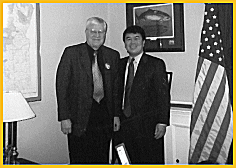
BIAOR President Bill Olson meets with 1st District Congressman David Wu while in
Washington, D.C. to attend the Brain Injury Association Public Policy Conference 2000.
Several factors should be considered when releasing a patient to return to work:
1. Neurologically, the brain needs time to repair itself after an injury just as a
broken bone or torn muscle does. There are no specific guidelines from the neurosurgical or rehabilitation
literature to support a "cookbook" approach to return-to-work issues.
After an aneurysm rupture or a severe injury with bleeding within the brain tissue (or
between the brain and the skull, such as a subdural bleed) the patient is usually advised not to resume
vigorous activity or working until the blood vessels are healed and scar tissue has formed within the brain,
typically by 6-8 weeks. If a neurosurgeon is involved, typically that doctor gives the OK.
For mild or moderate brain injuries, often with no abnormalities seen on a CT or MRI
scan, there are seldom neurological reasons why a person cannot return to work.
2. From a broader medical perspective, the physical manifestations of TBI can be quite
variable. Whether or not someone can return to work will depend on the types and severity of physical problems
he or she is experiencing - for example, spasticity, problems with balance, weakness, speech deficits,
dizziness or vestibular problems. Medical rehabilitation with knowledgeable physical, occupational, and speech
therapists can help patients improve or compensate for some of these problems, and is ideally performed prior
to returning to work. As with all attempts to return to work, the patient needs to have the physical skills to
perform the job. A logger needs balance and visual-perception, but not necessarily language skills; an
attorney needs verbal and reasoning skills, but not balance or arm/leg strength.
3. Cognitive and emotional problems are common after a TBI. Some research suggests
cognitive rehabilitation may help with memory or attention. Professional psychological counseling or
connecting with peers and support groups may also be helpful. Adaptation and compensation is neither easy nor
static. Physicians may prescribe medications to help with depression, anxiety, sleep disorders, or anger
control. Physical and/or cognitive fatigue can also be a problem.
Cognitive and emotional challenges are among the most difficult, and often stand in
the way of a patient's return to work. Vocational counselors can help design and coordinate a return-to-work
program that meets the individual's needs. Sometimes part-time work is best, especially initially. Job coaches
can help solve problems before they become big. Communication between all parties is often the key ingredient
to a successful return to work. A second key is a clear understanding of the expectations for the worker as
well as the employer.
When to return to work is a complex question. The answer is dependent on the extent of
brain injury and the remaining physical, cognitive, and emotional disabilities, as well as the demands of the
job itself.
Special thanks to Dr. Bryan Andresen, Rehabilitation Medicine Associates of
Eugene-Springfield, for providing the response to this month's FAQ.
Working with the VRD
Finding and maintaining employment following brain injury can be a challenging
process. For many survivors, the first step in the process is connecting with the Vocational Rehabilitation
Division (VRD). Counselors work individually with clients to document each client's work history, interests,
talents, aptitudes, education, preferences, and work goals. Successfully combining all these pieces in the
puzzle creates the foundation for the job search process.
Working with VRD does not always guarantee that the return-to-work process will be a
smooth one. Many clients have been frustrated when their expectations for finding a job haven't been met.
Knowing something about what VRD does and doesn't do can help prepare you to make the most of the services
offered.
Here are three common misconceptions about VRD:
VRD is an employment agency - you can make an appointment, describe the type of work
you're looking for, and they will set up interviews for you and link you to a position. In reality, finding
suitable employment following TBI is a process that involves learning about you and your needs, interests and
abilities; looking at the job market; building relationships with potential employers; and gradually making a
match. It takes time and lots of work.
VRD is a scholarship agency - if you want to return to school to pursue new
employment options, VRD can write the check. In reality, limited funds may be available to support schooling
or training. But this financial support only occurs in the broader context of a thorough work assessment and
return-to-work plan.
VRD is an employment enforcement agency - they can require employers to hire and
support people with disabilities. In reality, the way people follow the Americans with Disabilities Act (ADA)
is variable and depends to a very large extent on the interests, willingness and flexibility of each employer.
VRD works hard to build and nurture strong, positive relationships with potential employers so that a range of
job options are available to clients.
**************
"My name is Andrea B. I am a TBI survivor from May 1997. I was an inpatient for
four months and outpatient on the hospital campus for the next seven and a half. During that time I
participated in a Vocational Rehabilitation program that extensively tested me for work possibilities. I was a
former teacher but I was in severe denial as to my abilities. Three months after my release, I interviewed
successfully at a private school for a part-time position. However, I resigned after three months.
I will be obtaining work again soon through a more honest and direct affiliation with
my VR employment agency and will surely meet with success. They have helped me begin driving again which was a
prerequisite for me finding work. They are convinced I should find something that taps into my education, yet
also carefully considers my deficits. This is only possible through mutual cooperation and exploration."
**************
"Tips" to make your VRD experience a positive and productive one:
1. Bring your own ideas. When you meet with the VRD counselor, bring ideas for types
of work you are interested in. To get ideas, talk with friends and family, your doctor, rehabilitation
professionals, and others in your community. Interview friends to find out more about their work. There may be
jobs you haven't considered that would be a perfect match for you.
2. Consider volunteering to see if the job really fits you. Often we have very
specific ideas of the type of work we think we'd love. But when we actually start the job, we find that it
doesn't fit as well as we hoped. Volunteering in a position similar to the one you are seeking is a great way
to test the fit before actually starting a job. It's also a way to gain experience. Call the volunteer bureau
in your community and see if there are opportunities in your areas of interest.
3. Be a team player. Go to your first appointment at VRD with the expectation that you
will be a partner in the process. The vocational counselor knows the rehabilitation and disability fields, but
you know YOURSELF, your interests, strengths and weaknesses better than anyone else. Mutual planning and
decision making with your VRD counselor are critical parts of the process of locating the right position for
you.
4. Be ready to do some homework. Your counselor will work with you to develop a list
of activities to help you start exploring job options that could be a good fit for you. This might involve,
for example, completing interest inventories, visiting potential job sites, and talking with employees who
work in areas of interest to you. These activities are an essential part of a comprehensive return-to-work
planning process, and help ensure that the final outcome is a job that works for you.
Helping a person return to work is a process that
is best done by creating a partnership between the client and the counselor. The focus of the partnership is
gathering information, trying out activities, and assessing the best fit for each client's work capacity and
interests. This is the most successful way to make a good job match.
|
Consider a job coach:
People often need support to have a successful
work experience. Job coaches assist both the employee and the employer to make the job match work by teaching
the job, supervising, breaking the job into manageable parts for the client, and making modifications in the
job as necessary.
|
Our thanks to Bob Weaver, Vocational Counselor Specialist with Central Portland VRD
Office, and Wendy Hval, Job Coach Trainer with Job Coaching Associates in Portland, for providing the
information for this article.
Did you know?
The Employed Persons with Disability Program allows individuals to maintain Oregon
Health Plan benefits even if working. Ask your local Senior and Disabled Services Division (SDSD) office for
details.
Since 1987, Alternative Work Concepts (AWC) in Eugene has been assisting people with
cognitive and physical disabilities to find and maintain work. Taking referrals from Vocational
Rehabilitation, the Developmental Disabilities office, and private sources, AWC provides a comprehensive
program to assess, train, and support clients wanting to work.
Finding a match is the key
The first step in matching a client with a job is to conduct a thorough assessment.
Most clients who work with AWC have little, if any, job experience. The assessment helps identify the client's
abilities and interests. "The most important thing," says Liz Fox, Director of AWC, "is to find
out if they like the work." The assessment is conducted both at the AWC offices and in job sites in the
community. Staff spend a great deal of time assessing outside factors, such as what type of work environment
each client is interested in, how the client will get to work, and what schedule best suits his or her needs.
Family input is also considered. Once the general type of job is determined, AWC looks for funding to support
the job search, job development, training, and follow-up support. Funding most frequently comes from
Vocational Rehabilitation, the family, or the self-directed support program of the Developmental Disabilities
Division.
The crucial piece, according to Fox, is matching the job to the client's interests,
abilities, and work environment preferences. This avoids placing people where they are displeased or where
they might need extensive support.
No job that's right?: Create one!
For some clients, AWC will work with employers to create positions. Usually
entry-level, these jobs piece together tasks that other employees were doing, freeing up those employees to do
other things. Additional job responsibilities are often added as the client is ready.
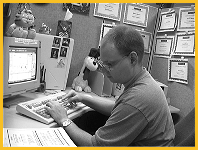 Dennis was hired to work in the mailroom at Symantec, a software development firm in Eugene. His
original duties included categorizing and filing registration cards, something mid-level managers had been
doing prior to Dennis' hiring. Once Dennis demonstrated his proficiency with the registration cards, the
employer added mailroom responsibilities and increased Dennis' hours to 30-40 hours a week. Dennis was hired to work in the mailroom at Symantec, a software development firm in Eugene. His
original duties included categorizing and filing registration cards, something mid-level managers had been
doing prior to Dennis' hiring. Once Dennis demonstrated his proficiency with the registration cards, the
employer added mailroom responsibilities and increased Dennis' hours to 30-40 hours a week.
Clients who are unable to complete job demands independently can be paired with
another employee to get the work done. For example, two employees, one with and one without disabilities, have
managed the photocopy room at Oregon Research Institute in Eugene for the past 12 years.
AWC staff maintain follow-up contacts at
each work site for a minimum of 3-4 months. This support ranges from regular meetings, to on-site visits, to
periodic phone calls. AWC staff provide education about work-related skills such as money management and
transportation, and are available to get involved again if an employee's job tasks change.
The primary goal of the AWC program is to help the client have a successful work
experience. As Fox says, "What we all want is respect, and to feel great about what we do. We try to
facilitate that for our clients."
To contact AWC, call (541) 345-3043.
The Vocational Rehabilitation program at Community Rehabilitation Services of Oregon (CRSO)
is part of a comprehensive rehabilitation program for individuals with TBI. CRSO also offers home care
services, medical rehabilitation, and brain injury education for schools and employers. In business for over
six years, the program has assisted with the vocational placement of over 90 clients with brain injuries.
Clients are referred to CRSO by physicians, the Vocational Rehabilitation Division,
the Commission for the Blind, and the Worker's Compensation Insurance Company, as well as attorneys. CRSO
vocational staff includes certified vocational consultants, job coaches, and an occupational therapist.
Although many clients are returning to previous employment, some are unable to return to their prior job and
are looking for a new position. According to Jan Johnson, Director of CRSO, the way CRSO staff work with a
client depends on the individual's needs.
Clients who are unable to return to their previous job begin with a career assessment
inventory to assist them in finding the best match for their skills and interests. Staff then work with each
client on job skills such as resume development and interviewing strategies, and provide help in finding a
job. Work evaluations frequently precede job placement. After placement, staff provide intensive support
through job coaching, case management and regular communications with the client, family, and employer.
For clients returning to their previous place of employment, CRSO staff carefully
consider the match between the client's current ability level and the job requirements. Staff work closely
with the employer to identify accommodations that can be implemented so that the client can be successful at
work. Follow-up support is essential to maintain the placement. CRSO staff have found that with proper
assessment and supports, many individuals with brain injury can return to work.
What's critical: Teamwork
Over the past 6 years, over 80% of the clients placed by CRSO have maintained their
jobs (a rate much higher than is cited in the literature on job retention for individuals with brain injury).
Ms. Johnson attributes much of this success to CRSO's emphasis on developing partnerships and maintaining
communication with employers. Staff provide frequent, targeted follow-up for at least 3 months, and often up
to a year. This allows them to identify and correct potential problems before they become real barriers to
successful employment.
To contact CRSO in Eugene, call (541) 342-1980.
Betty Nelson Retires
Linda L. Hill, M.S., CRC, LPC, CLCP
Betty Nelson of Nelson Rehabilitation Consultants has decided to retire after 34 years
of service as a Vocational Rehabilitation Counselor. Betty has
been a very active member of the rehabilitation community, working in private practice (1982-present), for the
Oregon Vocational Rehabilitation Division (1972-1982) and for the California Department of Rehabilitation
(1968-1971). In 1988, Betty was named Counselor of the Year by
the Oregon Association of Rehabilitation Professionals.
Betty has been a member of the National and Oregon Brain Injury Associations since
1986, the National Spinal Cord Association since 1976, the Oregon Trail Chapter of the Spinal Cord Association
from 1976-1992, the Board of Directors of Still People since 1998 and the Advisory Board for Homeward Bound
since 1998. She has served on several additional professional boards, and has been a tireless advocate for
individuals with head injuries and spinal cord injuries.
I have had the pleasure of knowing and working with Betty for over 16 years. She has
served as a tremendous resource and role model for numerous professionals working in the rehabilitation field.
But she is best known for her tireless support of her clients and her commitment to improving the quality of
their lives.
Thank you, Betty. You will be missed.
In Memory of Charisse Wilson
It is with great sadness that we note the passing of Charisse A. Wilson who died on
May 6. Charisse was one of the original members of the TBI Club in Portland and was able to be with her
friends at the April meeting. Her smile and words of encouragement will be greatly missed.
As a young child, Charisse was the poster child for the Cystic Fibrosis Foundation.
Contributions in her memory can be sent to the Cystic Fibrosis Gift Account at 5331 SW Macadam, Portland, OR
97201.
|
Anytime
My breathing fails
I know not when
If the sun's shining bright,
Or at the day's end.
The help I need
I know not when,
At anytime,
My life may end.
So be here for me
At anytime.
The times of need
Are no choice of mine.
God's with me always
His day never ends.
He use's you, for my
needs to attend
He'll call me soon
I'm not sure when,
So stay by my side
Until the end.
As a thief in the night,
We know not when,
He'll shine eternal light.
'Anytime' is Mother's Day.
By Alice Wilson (Mother of Charisse)
|
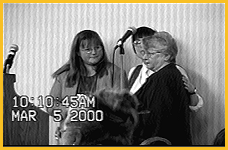
Joan Brown accepts Bob Brown's
2000 Founders Award for Outstanding Volunteer Service.
Let's Network!! By
Robert Miller
In the last issue, we reviewed a range of and email appliances that can be used as
alternatives to computers. Once you have the right equipment, the next step is selecting an internet service
provider (ISP). There are a number of methods for accessing email and the internet. Some public libraries,
schools and clubs offer free access. If you have your own computer you will have the convenience of choosing
your own schedule. To select an ISP, check with your support group, local computer store or use someone else's
computer to get information from these addresses:
I like 'FREE' things, but few things are really free. The ISPs listed as 'free' are
financed through advertisements that show up on your display or monitor. Unless you have a very small display,
these ads will not interfere with your use. Other 'costs' of getting this free service include somewhat
reduced performance quality and limited local access.
The free ISPs are generally available only in larger metropolitan areas, although
rural areas are gradually getting connected. If you don't live in a local access area, you will have to pay
long distance charges, based on the amount of time you use. By checking your email once daily and only
browsing the internet occasionally, you can keep your long distance phone charges to a minimum.
Below is a list of free internet service providers
to consider. The local calling area is different for each one, so find out which ones cover your area
before you make your final decision.
Need additional help? Check with your support group or contact me at (541) 258-6641 or
[email protected]. We can try to fix things by distance or maybe we can set up a workshop where several of us
can find a solution together.
Let's NETWORK!
A number of helpful resources are available for individuals with disabilities
interested in finding work. Several of these are described below. For assistance finding resources for your
particular situation, contact the OBIRN office at 1-800-544-5243.
Resource Review
When Your Teenager is Injured: Preparing for Work and
Adulthood (1997) Marilyn Lash, Paul Kahn & Gary Wolcott $10
This manual focuses on the required transition planning for adolescents receiving
special education. Included are discussions of ways to integrate transition plans into the student's
Individualized Education Plan starting at age 14, as well as how to look for a job, prepare for interviews,
discuss the disability, and negotiate accommodations. Common biases of employers are frankly discussed, along
with strategies for preventing discrimination because of a disability. Available through: Lash & Associates Publishing (919) 562-0015
Red Book on Work Incentives: A Summary Guide to Social Security and Supplemental
Security Income Work Incentives for People with Disabilities. (1999)
This guide was developed by the Social Security Administration as an overview to the
work incentive provisions. Available through: http://www.ssa.gov/work/redbook99.html or contact OBIRN
Video Pick
Everyone Can Work Video
55 minutes, 1/2" VHS, Closed Captioned, $79.00
This video takes an intimate look at the lives of five successful employees with
significant disabilities. Shot on location at job sites, in living rooms and offices, it features interviews
with workers, job coaches, families and employers. Each story touches on a primary issue related to supported
employment. This video features Dr. Paul Wehman, a leading spokesman for people with disabilities and their
right to work. Available through: HDI Publishers (800) 321-7037
Help Me Find . . .
What resources are available to help prepare a family member who is brain injured for
employment?
OBIRN has several excellent articles from the Brain Injury Association of Florida that
offer suggestions for improving ones' chances of finding and keeping a job. These articles offer tips on
writing resumes, interviewing, learning and maintaining the job, and more. Contact OBIRN for copies.
Another resource is Successful Job Search Strategies for the Disabled: Understanding
the ADA (1994). This comprehensive book by Jeffrey G. Allen, an employment attorney, covers such topics as ADA
regulations, overcoming misperceptions, hiring, promoting, civil process, reasonable accommodations, job
leads, interviewing, resumes and cover letters. The book is expensive so check with your local public or
university library. If you have problems finding a library with a copy contact OBIRN and we'll try to help.
Finally, the Job Accommodation Network's (JAN) Employment Tips page summarizes a range
of employment resources including a list of general and disability-related job banks, and offers tips on the
employment process and strategies to consider when seeking employment. Check out the site at http://www.jan.wvu.edu/media/EMPLOYMENTTIPS.html.
| Wandering the Web
Equal Employment Opportunity Commission (EEOC)
http://www.eeoc.gov/
This site provides a basic introduction to your rights and responsibilities under
federal equal employment opportunity laws, including: ADA - Your Responsibilities as an Employer; ADA - Your
Employment Rights as an Individual With a Disability; and ADA - Questions and Answers.
President's Committee on Employment of People with Disabilities http://www50.pcepd.gov/pcepd/
The Committee provides information, training, and technical assistance to America's business leaders,
organized labor, rehabilitation and service providers, advocacy organizations, families and individuals with
disabilities. |
In order for you to fill out the form you need to have Acrobat Reader installed on your computer. If you don't
have Acrobat Reader on your Computer, you may download a "FREE" reader version. Click on the icon
below another browser window will open and will direct you how to install the program.

Brain Injury Association of Oregon Membership Form is offered as a PDF file to be downloaded
with Acrobat. This will enable you to view/fill out form and print to send to BIAOR.
Membership Form
|
The Oregon Brain Injury Resource Network's (OBIRN) mission is to improve access to
information and services for individuals with brain injury, their families, and the professionals who serve
them. For assistance locating any of these resources, to submit a question, or for other questions you have,
please contact OBIRN.
Laura Beck
OR Brain Injury Resource Network
345 N. Monmouth Avenue
Monmouth, OR 97361
Tele: 800.544.5243 or 503.585.0855
Fax: 503.838.8150
Your name will not be used in the newsletter.
|
Brain Injury Association of Oregon (BIAOR)
1118 Lancaster Dr. NE
PMB 345
VOICE:
503.585.0855 (Salem)
TOLLFREE:
800.544.5243
EMAIL:
[email protected]
WEBSITE:
www.biaoregon.org
|
Teaching Research, Eugene
Voice:
541.346.0593 (Eugene)
TOLLFREE:
877.872.7246
EMAIL:
[email protected]
|
|
Brain Injury Support Group of Portland
(BISG)
2145 NW Overton
Portland, OR 97210-2924
VOICE:
503.413.7707
EMAIL:
[email protected]
WEBSITE:
www.pacifier.com/~headsup/
|
Oregon Brain Injury
Resource Network
VOICE: 503.585.0855 (Salem)
TOLLFREE:
800.544.5243
EMAIL:
[email protected]
WEBSITE:
www.tr.wou.edu/tbi
|
|
Newsletter Submissions or address corrections
99 West 10th Avenue, Suite 370
Eugene, OR 97401
VOICE:
541.346.0572 (Eugene)
TOLLFREE:
877.872.7246
EMAIL:
[email protected]
|
Oregon TBI Model Systems
VOICE:
503.494.7015
EMAIL:
[email protected]
WEBSITE:
TBA
BIAOR- Open List
Robert Miller, facilitator
EMAIL:
[email protected]
VOICE:
541.258.6641
|
|